Every so often, a client asks me for TIFF files because “the designer says TIFF is better.” It reminds me of my earlier post on high resolution images, how many long-held beliefs in photography aren’t actually based on best practice, but on assumptions. The JPEG vs TIFF debate falls squarely into that category.
Some context
I’ve been involved in digital photography standards development for over 30 years, including work with:
- ISO TC/42
- Universal Photographic Digital Imaging Guidelines
- Australian Photographic Digital Imaging Guidelines
So when I talk about file formats, I’m not repeating internet folklore. I’m looking at what standards bodies, cultural institutions, industry guidelines and what research recommends.
First question: What is the final use?
Before specifying a file format, you must ask:
- Is the image for online use?
- Is it for print production?
- Is it for long-term archiving?
The answer to JPEG vs TIFF depends entirely on that context.
1. Online use
For web, social media, email, and digital delivery, JPEG is the global standard. It is universally supported, efficient in file size, and visually indistinguishable from TIFF at appropriate quality settings. Supplying TIFFs for online use makes no practical sense.
2. Print production
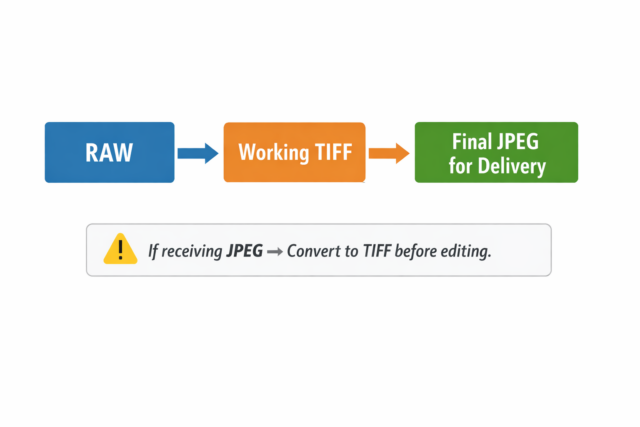
For high-quality print production, an 8-bit JPEG saved at maximum quality is visually indistinguishable from an 8-bit TIFF for final output, assuming no repeated resaving and recompression. Resaving a JPEG erodes the quality. In that case, the retoucher can save the JPEG as TIFF before editing.
Modern workflows, RIPs, and print pipelines handle JPEG perfectly well.
If the file is already properly prepared and final, JPEG is entirely suitable for delivery.
3. Archiving and cultural preservation
This is where TIFF enters the picture more strongly. No pun intended.
The Universal Photographic Digital Imaging Guidelines recommend 8-bit TIFF for long-term preservation and institutional storage. Cultural institutions commonly use 8-bit uncompressed TIFF for future compatibility.
Why?
- It is well documented.
- It is stable.
- It is widely supported.
- It is not dependent on lossy compression.
For master archives, TIFF is often appropriate. For routine client delivery? That’s a different question.
The data recovery argument
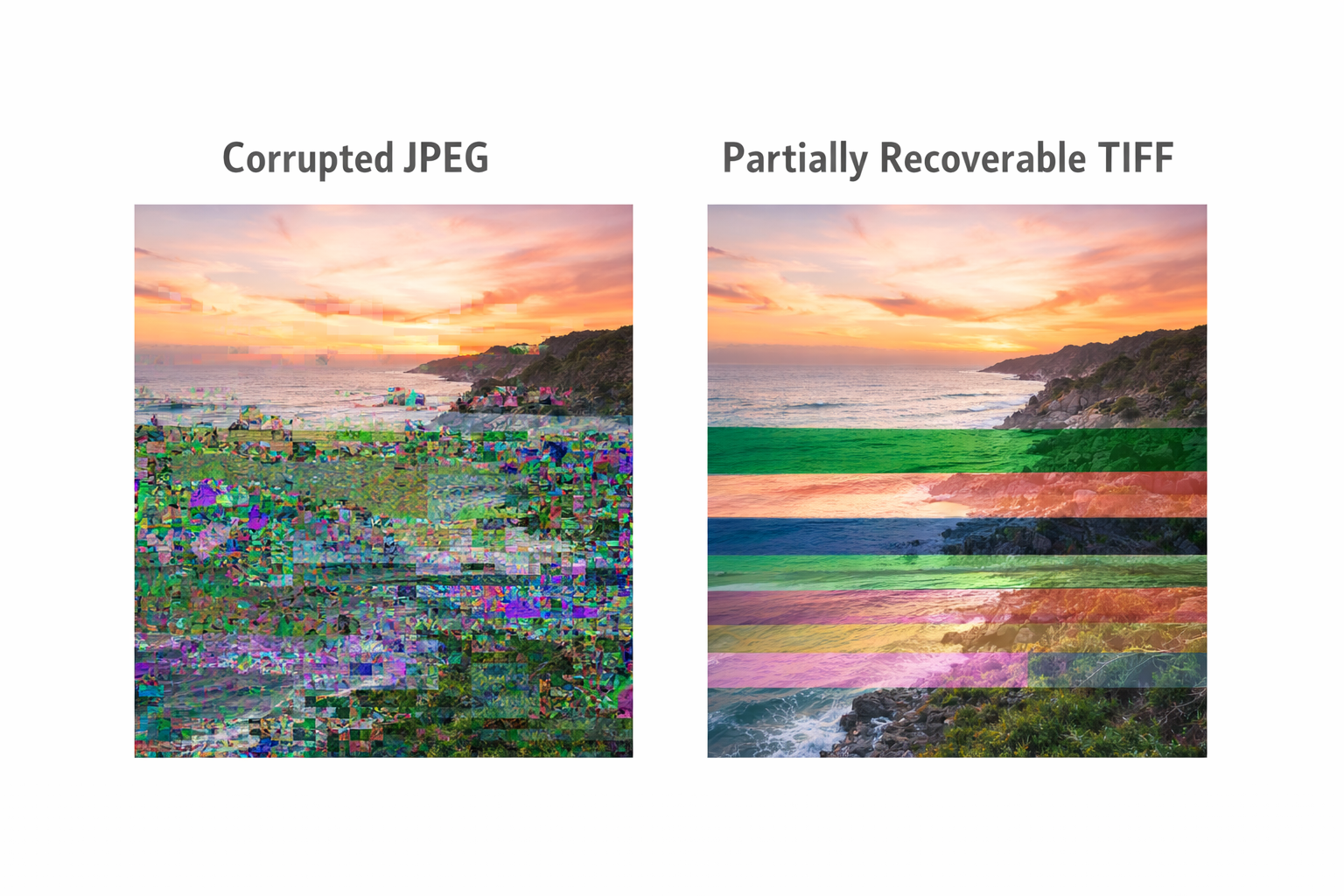
One valid technical point: If an image file becomes corrupted, an uncompressed TIFF is generally more recoverable than a compressed JPEG.
JPEG compression works across the whole image structure. Corruption can affect larger portions of the file. TIFF, especially uncompressed TIFF, stores data in a way that may allow partial recovery.
But we must keep this in perspective. If corruption is a real risk, you should have:
- Backups
- Redundant storage
- Proper digital asset management
File format is not a substitute for professional archiving best practice.
Editing considerations
If you receive a JPEG and need to edit it extensively:
- Open it.
- Immediately save a copy as TIFF.
- Perform all editing on the TIFF.
- Deliver final output as required.
Why? Because repeated JPEG recompression can introduce cumulative artefacts. Converting once to TIFF prevents generational loss.
This is good workflow practice, not evidence that JPEG is bad.
TIFF comes in many flavours
Another common myth: “TIFF is higher quality.” TIFF is a container format, not a quality guarantee.
There are many TIFF variations:
- 8-bit vs 16-bit
- Uncompressed vs LZW vs ZIP compression
- Windows, little-endian vs Mac, big-endian byte order
- Different embedded metadata structures
Two TIFF files can behave very differently, and support is less extensive than JPEG. TIFF is more complex than JPEG, not automatically superior.
Size matters
TIFF files are dramatically larger than JPEG files.
That affects:
- Delivery time
- Upload and download speeds
- Storage costs
- Cloud transfer
- Backup systems
- Computer and device performance
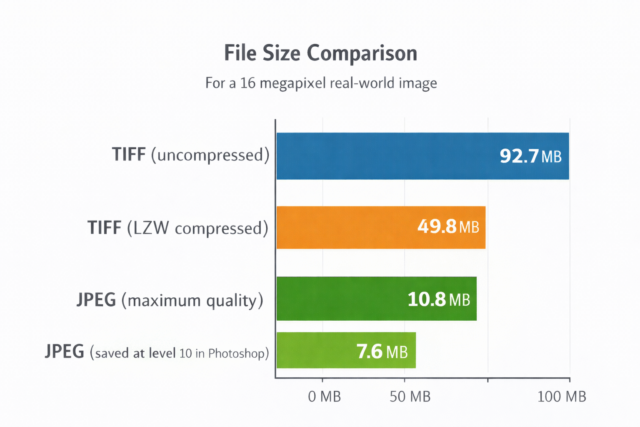
For high-volume workflows, these differences are not trivial. A maximum-quality JPEG can be a fraction of the size of an equivalent TIFF, with no visible difference in final output.
Efficiency is not unprofessional. It is DAM best practice.
TIFF ownership and standards
TIFF was originally developed by Aldus and is now owned by Adobe, with specifications licensed to ISO. All camera raw formats are also based on TIFF structures, including TIFF-EP.
The future alternative in the standards world is ISO DNG: ISO 12234-4. DNG is based on TIFF-EP, well documented and designed for long-term interoperability. But that’s a story for another day.
So is JPEG just as good?
For final delivery of finished images intended for:
- Online use
- Client handover
- Print reproduction
- Publication
Yes, when saved at appropriate quality, JPEG is just as good as TIFF.
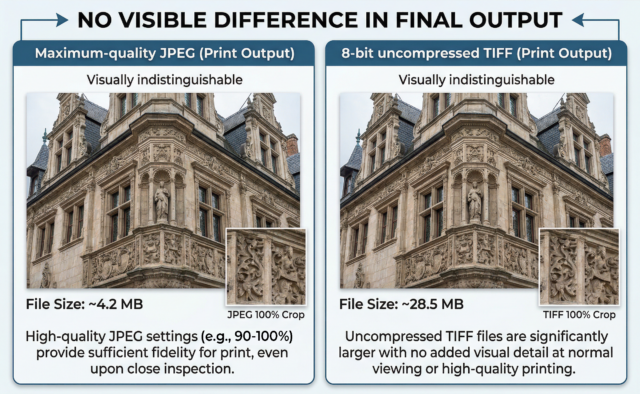
The “TIFF is better” statement usually confuses editing workflow requirements with delivery requirements. They are not the same thing.
What the standards say The Australian Photographic Digital Imaging Guidelines recommend:
- JPEG for web use
- TIFF, 8-bit, uncompressed for print, or JPEG at level 12 compression
Bottom line
Ask one simple question: What is the final purpose of the file?
- If it is archive preservation, TIFF may be appropriate.
- If it is a working file for editing, TIFF is sensible.
- If it is final delivery, JPEG is entirely professional.
File format should serve workflow and purpose.
After more than three decades working in digital imaging standards, I can say confidently:
- TIFF is not better.
- JPEG is not worse.
They are options, each appropriate in the right context.