If you had told me in the late 1990s that I would still be talking about raw file formats more than 25 years later, I probably would have laughed. Back then, we were all trying to make sense of digital photography as it found its footing, full of excitement and uncertainty.
Color management itself was barely a standard until the release of Adobe Photoshop 5. Camera raw files existed, but they were fragmented, proprietary, and tied closely to specific camera models. Every manufacturer had its own approach. Every new camera introduced another format. And behind it all was a quiet but very real concern: What happens when these formats are no longer supported? What happens to our photos?
For me, that question has always been personal. My work, my history, my family photos, the moments I want to preserve beyond my lifetime, all depend on formats that must stand the test of time. That concern has never left me.
Before Social Media
At the time, professional photographers from around the world gathered on the forum run by Rob Galbraith. It was a different kind of online space. There were no pseudonyms, only real names. Discussions were respectful but often intense, and knowledge was shared openly.
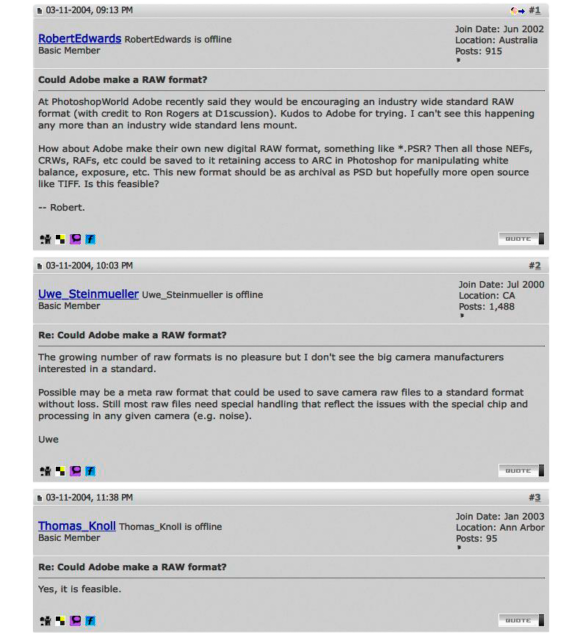
In March 2004, I asked the forum a question that had been on my mind for years:
“Could Adobe make a RAW format?”
Not just any format, but one that:
- Preserved edits
- Was fully documented
- Could serve as a long-term archive
I even gave it a name, PSR, for Photoshop Raw. The response was skepticism. Many felt it was not realistic. There were too many variables, too many competing interests.
Then, just two hours later, a reply came in from the person who invented Photoshop, Thomas Knoll:
“Yes, it is feasible.”
Short, direct, and confident. What I did not know at the time was that he was already working on what would become Digital Negative.
The birth of DNG
In September 2004, Adobe announced Digital Negative (DNG). It brought together everything many of us had been hoping for:
- An open and documented RAW format
- Designed for long-term access
- Built on the foundation of TIFF-EP (ISO 12234-2)
The idea was straightforward. Create a format that could outlast individual cameras, companies, and trends. Adoption took time, but it came. Manufacturers such as Leica, Pentax, Ricoh, Sigma and DJI adopted DNG as a native format.
Then came a major shift. Apple and Google brought DNG into smartphones. Raw photography was no longer limited to professionals. It became something millions of people could use every day.
Resistance
Over the years, I have spoken with many companies about supporting DNG. The most common response has been: “It is owned by Adobe, and they are our competitor.”
That argument does not hold up. DNG is fully documented and openly licensed. Anyone can use it. Adobe has done this before. TIFF is another example, developed by Adobe and licensed through ISO. Nearly all camera raw formats, including DNG, are built on TIFF-EP. This is not about ownership. It is about interoperability and preservation. That has always been the goal.
International Organization for Standardization
In February 2013, the Australian Institute of Professional Photography invited me to attend an ISO meeting on photographic standards. The meeting was convened by Standards Australia and brought together a wide range of voices from across the industry. Manufacturers, scientists, government representatives, technicians, and photographers all had a seat at the table.
For me, it was an important step. I was no longer just part of the conversation. I was part of the process. Since then, I have continued advocating for DNG to become an ISO standard.
A milestone
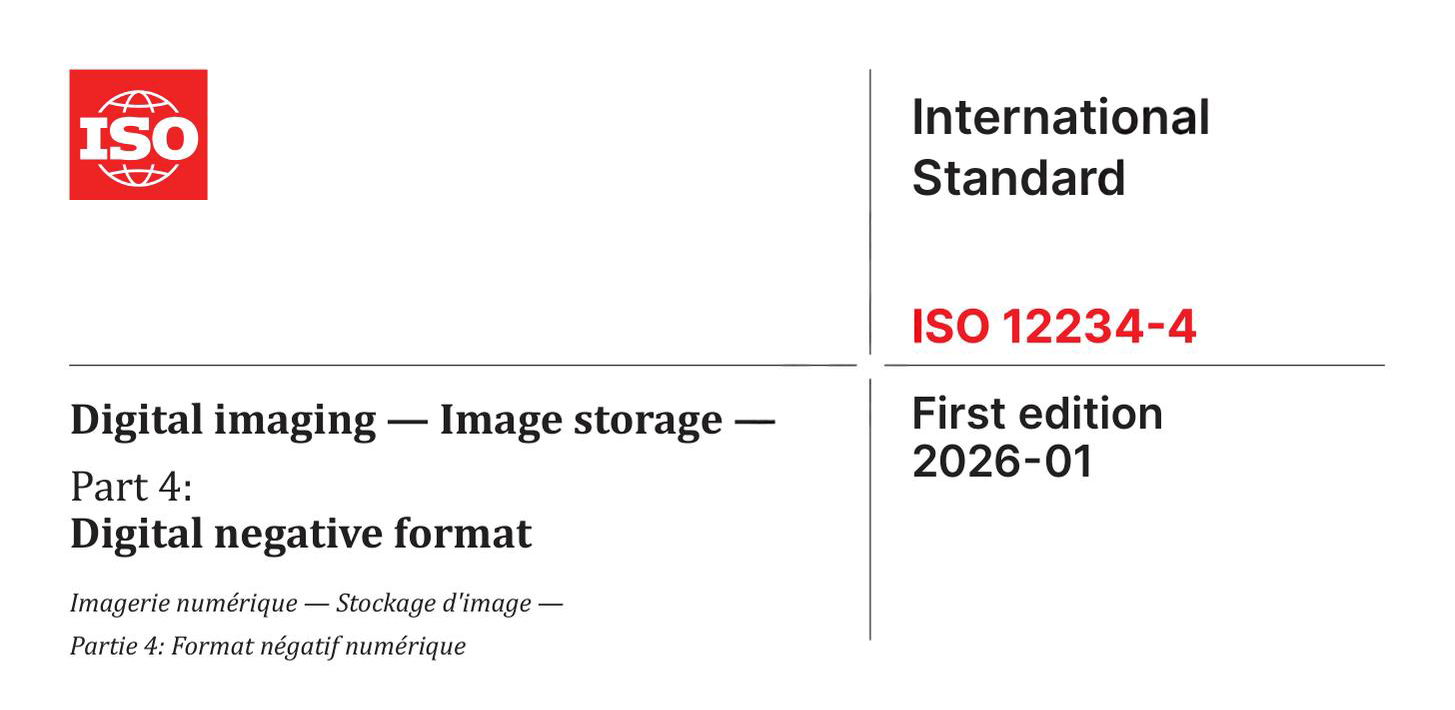
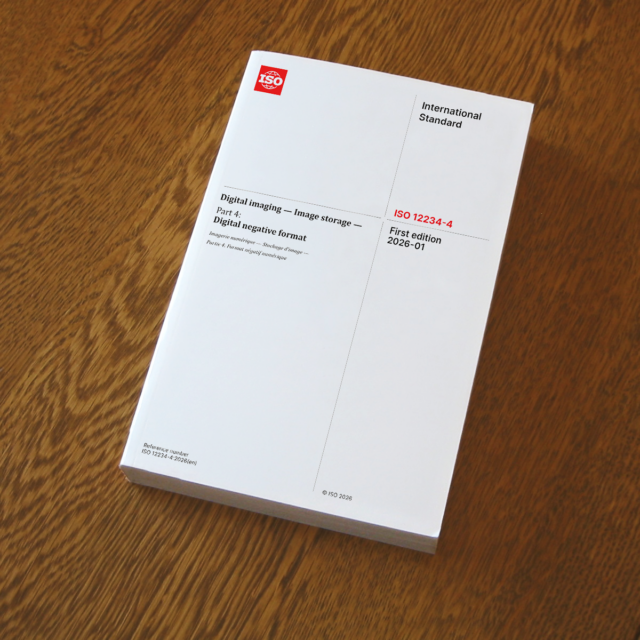
This week marks a significant milestone: ISO 12234-4 has been published.
DNG is now an international standard, alongside formats such as TIFF and PDF. After more than two decades of discussion, persistence, and advocacy, the goal has been achieved. What began as an idea is now a globally recognised standard.
Where to from here
Now the responsibility shifts. Camera manufacturers no longer have a valid reason to avoid supporting DNG. Many already do. Others can follow the example of companies like Pentax, offering both a proprietary format and DNG.
Real change, however, does not come from standards alone. It comes from photographers. If you care about your images, your work, your memories, your legacy, then this matters. Ask manufacturers to support DNG. Choose tools that prioritise openness and long-term access.
Because this has never only been about file formats. It is about making sure the photographs we create today can still be seen in the future.